Muhammad

صلى الله عليه وسلم

Peace and Blessings Be Upon Him • 570-632 CE

Explore the significant events and milestones in the life of the final messenger of Allah, Prophet Muhammad. Use the timeline above or the navigation menu to discover different periods of his blessed life.

00-10 yr
10-20 yr
20-30 yr
30-40 yr
40-50 yr
50-60 yr
60-65 yr

1. Birth in Makkah

Muhammad ﷺ was born in the Year of the Elephant (570 CE) in the noble city of Makkah, during the month of Rabi' al-Awwal. His birth occurred on a Monday, a day that would forever be blessed in Islamic tradition.

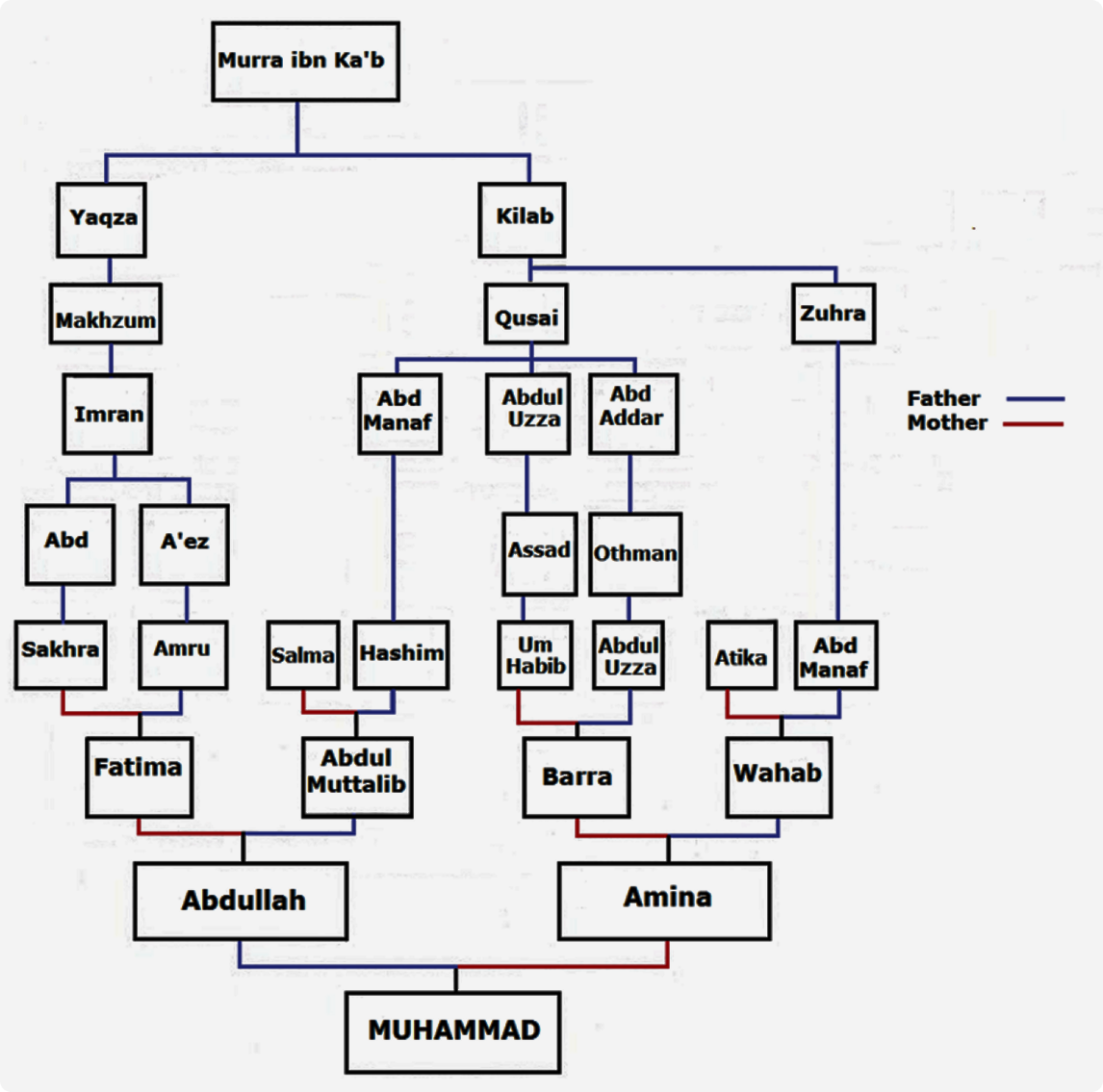
He was born into the prestigious tribe of Quraysh, from the clan of Banu Hashim. His father, Abdullah ibn Abdul Muttalib, had passed away before his birth, and his mother was Aminah bint Wahb, a woman of noble character and lineage.

The night of his birth was marked by extraordinary signs witnessed by his mother and others. His mother reported that a light emanated from her that illuminated the palaces of Syria, and she experienced no pain during childbirth, which was extraordinary.

From the moment of his birth, he was destined for greatness, though he would face trials and tribulations that would shape him into the final Messenger of Allah to all of humanity.

Birth in Makkah

2. Family & Lineage

The Prophet Muhammad ﷺ belonged to the noblest of Arab lineages, tracing his ancestry back to Prophet Ibrahim (Abraham) ﷺ through his son Ismail ﷺ. This sacred lineage was well-known and highly respected among the Arabs.

His father, Abdullah, was the son of Abdul Muttalib, the chief of Banu Hashim and a respected leader of Quraysh. Abdullah was known for his handsome appearance and noble character. He died while on a trading journey to Syria, just months before Muhammad's birth.

His mother, Aminah bint Wahb, came from the Banu Zuhrah clan, another prestigious branch of Quraysh. She was known for her piety, nobility, and strong character. The marriage between Abdullah and Aminah united two of the most honored families in Makkah.

His paternal grandfather, Abdul Muttalib, was the custodian of the Kaaba and provider of water to the pilgrims (Zamzam). He was a man of great wisdom and honor, respected throughout Arabia for his integrity and leadership.

Family & Lineage

3. Time with Halima Sadia

Following the custom of noble Makkan families, the infant Muhammad ﷺ was entrusted to a Bedouin wet nurse named Halima al-Sa'diyya from the tribe of Banu Sa'd. This practice allowed children to grow up in the pure desert environment, developing strong physiques and eloquent Arabic speech.

Halima initially hesitated to take the orphaned child, as wet nurses typically preferred children whose fathers were alive and could provide generous compensation. However, she was the only one who had not yet found a nursling, so she accepted Muhammad ﷺ, and this decision transformed her life completely.

From the moment she took him, blessings began to flow abundantly. Her weak camel became strong, her dried-up sheep gave plentiful milk, and prosperity came to her household. These were among the early signs of the special nature of this blessed child.

Muhammad ﷺ spent approximately four to five years with Halima and her family in the desert. During this time, an extraordinary incident occurred: two angels came and opened his chest, removed his heart, cleaned it, and returned it. This event, known as the "opening of the chest," purified him from any trace of Satan's influence.

Halima was reluctant to return him to his mother, so blessed had her life become. Even after returning him, she would visit him frequently, having developed a deep love for the child who brought such goodness to her life.

Time with Halima Sadia

4. Passing of His Mother

When Muhammad ﷺ was six years old, his mother Aminah decided to take him on a journey to Yathrib (later known as Madinah) to visit the grave of his father Abdullah and to see her relatives from the Banu Najjar tribe.

The journey was approximately 500 kilometers, and young Muhammad ﷺ traveled with his mother and their devoted servant, Umm Ayman (Barakah). They stayed in Yathrib for about a month, during which Aminah showed her son the places connected to his father and introduced him to his maternal relatives.

On the return journey to Makkah, tragedy struck at a place called Abwa, located between Makkah and Madinah. Aminah fell seriously ill and, despite the care she received, she passed away and was buried there in that desolate place.

At the tender age of six, Muhammad ﷺ had lost both his parents. Umm Ayman, grief-stricken but dutiful, brought the orphaned child back to Makkah, where he was received by his grandfather, Abdul Muttalib. This profound loss at such a young age would deepen the Prophet's empathy for orphans throughout his life.

The Prophet ﷺ never forgot his mother. Years later, when he passed by her grave during the conquest of Makkah, he wept and said, "I sought my Lord's permission to visit my mother's grave, and He gave me permission. So visit graves, for they remind you of death."

Passing of His Mother

5. Care by Abdul Muttalib

After the passing of his mother, six-year-old Muhammad ﷺ was taken under the care of his grandfather, Abdul Muttalib ibn Hashim, the chief of the Quraysh and the most respected man in Makkah. Abdul Muttalib was approximately 80 years old at the time.

Abdul Muttalib had a special affection for his grandson that exceeded his love for his own children. He recognized something extraordinary in the young boy and gave him unprecedented privilege and attention. Muhammad ﷺ was the only grandchild allowed to sit on Abdul Muttalib's special mat in the shade of the Kaaba, a position of great honor.

When his uncles tried to move the young Muhammad from this place of honor, Abdul Muttalib would say, "Leave my son alone. By Allah, he has a great future." He saw in him qualities of wisdom, thoughtfulness, and nobility that were remarkable for a child of his age.

Abdul Muttalib would often be seen walking through Makkah with young Muhammad ﷺ, introducing him to the city's notables and teaching him about his family's responsibilities toward the Kaaba and the pilgrims. These two years under his grandfather's care were filled with love, honor, and important lessons.

When Muhammad ﷺ was about eight years old, Abdul Muttalib fell ill. On his deathbed, he called his son Abu Talib and entrusted him with the care of Muhammad ﷺ, saying, "He is going to be someone great. Take care of him." Abdul Muttalib passed away, leaving young Muhammad ﷺ an orphan once more, but with a guardian who would prove devoted and protective.